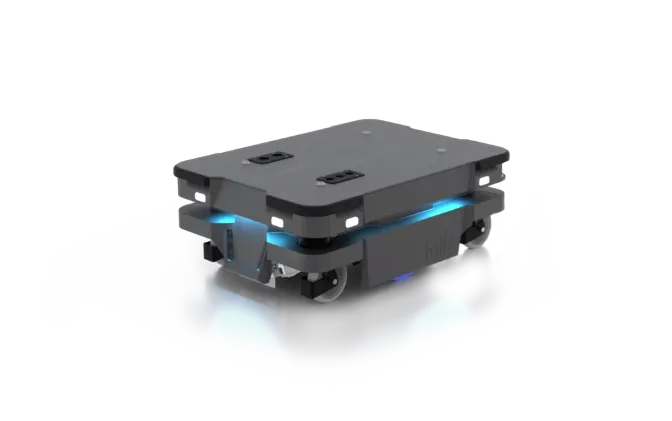
The researchers measured the MiR250's static base-positioning accuracy at a median of 24.9 mm and dynamic cross-track accuracy at a median of 16.2 mm, characterizing its error pattern as "consistently offset by ~2.5 cm rather than usually accurate with occasional errors," and concluded manufacturer specs "do not predict deployed positioning accuracy."
- More accurate (static and dynamic) than the KUKA KMR and Boston Dynamics Spot in the same test
- Completed the full 10-iteration dynamic trajectory protocol without failure, unlike Spot which ran out of battery
- Standard ROS interface allowed it to be controlled and logged the same way as the other platforms
- Static positioning error consistently offset by about 2.5 cm
- Less accurate than the newer KUKA KMP-1500 (24.9 mm vs 8.2 mm median static error)
- One physically-impossible/corrupted pose had to be identified and removed from the dataset